
Munich, Between Transit and Stillness
A few years ago, during a technology conference in Munich, I found myself oscillating between two worlds: the accelerated cadence of innovation, and the deliberate stillness of ritual.
My hotel—minimal, modern, with a balcony exposed to generous afternoon light—sat within walking distance of Bayerstraße, one of the principal arteries extending from München Hauptbahnhof, the city’s central station. This area, often dismissed as purely functional, reveals unexpected texture when one allows time to dilate. Cafés spill outward. Conversations overlap. The air carries both movement and pause.
It was there, between obligations, that I discovered one of Munich’s most established tobacco houses: Pfeifen Diehl. A serious institution. Traditional. Uncompromising. Its website, characteristically, remains in German—an implicit statement about identity rather than accessibility.
Inside, the interaction was precise. No theatrics. No overselling. A gentleman behind the counter suggested something outside my usual Cuban rotation: Oliva Cigars.
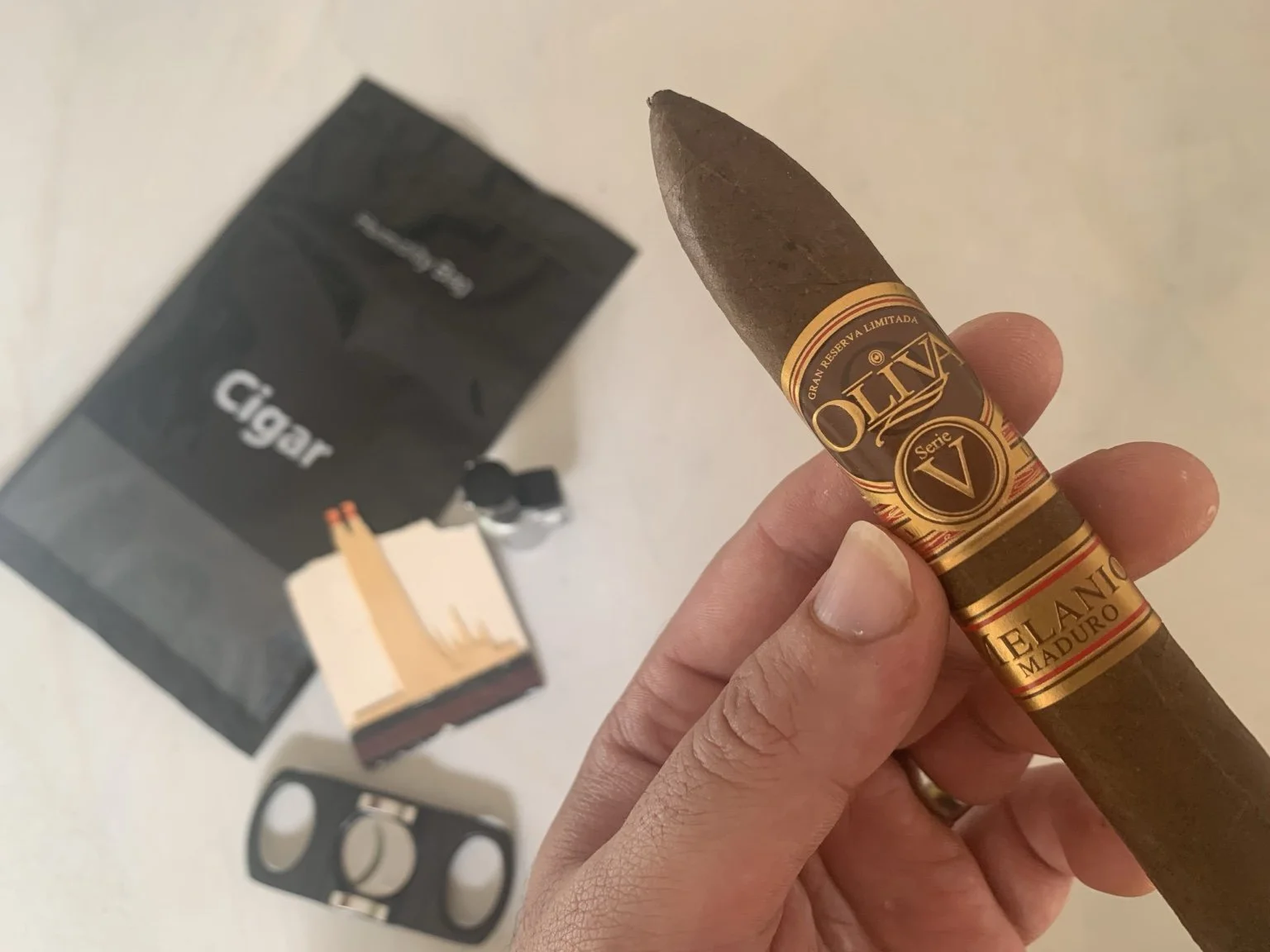
Oliva Serie V Melanio Maduro
First Encounter: Oliva and the Architecture of Consistency
Three cigars were recommended. Three formats. Each calibrated for a smoking window of approximately 40 to 50 minutes.
This was my introduction to the Oliva profile—later deepened through the Oliva Serie V Milano, a cigar that would become, over time, a reliable constant.
The first was enjoyed alone, on the balcony.
It burned long—unexpectedly so—approaching the temporal footprint of a Churchill. Yet it never imposed itself. The strength was present, structurally sound, but restrained. The defining quality was not complexity in the Cuban sense, but consistency. A controlled evolution. No erratic transitions. No collapse in the final third.
In this respect, the experience mirrored the quiet assurance of a glass of Redbreast 12 or even the maritime depth of Lagavulin 16—not because of identical flavour profiles, but because of their shared reliability. They deliver what they promise, every time.
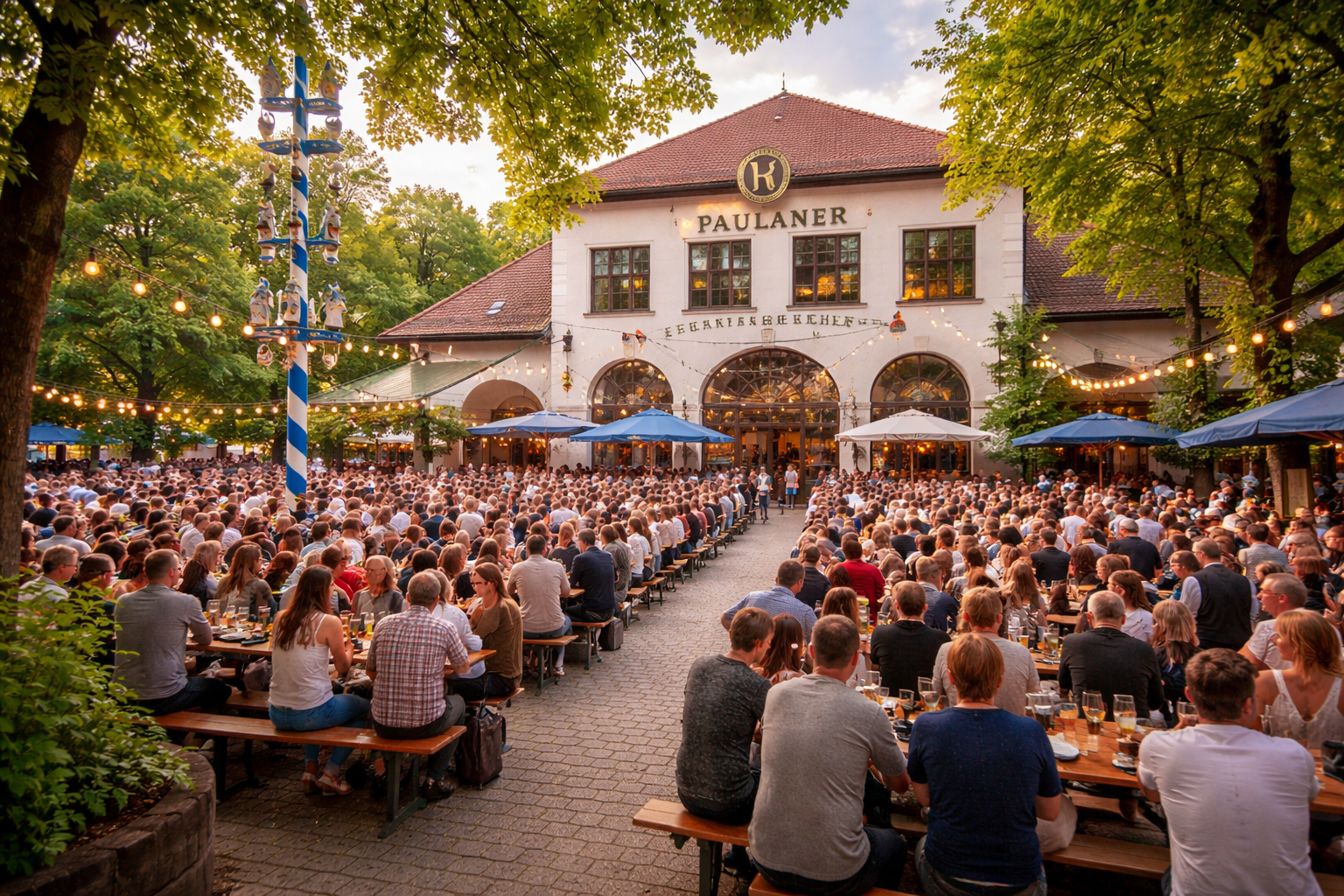
Beer Gardens and Peripheral Awareness
Munich’s beer gardens extend this experience into a collective dimension. Establishments such as Augustiner-Keller, Hirschgarten, and Paulaner am Nockherberg provide expansive outdoor settings where time is not merely spent—it is absorbed.
In designated outdoor areas, smoking is typically tolerated, if not formally structured, and it was in one such peripheral space—never central, always slightly withdrawn—that the second and third cigars unfolded.
Around me: fragments of dialogue. Half-finished sentences. Laughter that never escalated into noise. People waiting. People arriving. People simply existing in shared space.
The cigar functioned as a boundary. Not isolating—but filtering.
The Proustian Mechanism
What occurred next is difficult to quantify, yet entirely precise in its effect.
The combination of warmth, tobacco, and ambient sound triggered something analogous to what Marcel Proust famously described through the Madeleine episode—a sudden, involuntary return of memory, not as narrative, but as sensation.
Munich dissolved.
In its place: the Ligurian coast. The narrow continuum between Santa Margherita Ligure and Rapallo. Late afternoon. Shops closing. Voices emerging—not loudly, but rhythmically. The pre-cocktail hour, where presence mattered more than activity.
Northern Italy carries a restraint distinct from the south. Less theatrical. More measured. Conversations hover rather than erupt. That exact tonal quality—unexpectedly—reappeared in Munich’s side streets.
And the cigar became the conduit.
Time, Suspended
What defines such an experience is not flavour alone, nor setting, nor even memory in isolation. It is the synchronisation of all three.
For a brief interval, time did not pass in the conventional sense. It expanded. Each draw elongated perception. The background—wind, distant movement, indistinct voices—became foreground.
There was no urgency to return. No compulsion to document. No fragmentation of attention.
Only continuity.

Closing Reflection
Oliva cigars may not always pursue the layered depth of certain Cuban vitolas, but they achieve something arguably more difficult: repeatable satisfaction.
In Munich, that quality aligned perfectly with circumstance. A city in motion, experienced in stillness. A structured day interrupted by unstructured awareness. A present moment unlocking a distant past.
Not every cigar does this.
But when it happens, the object disappears—and what remains is memory, reassembled in smoke.
